



FELDSPATHIC VENEERS IN LONDON
Veneers that announce themselves are almost always too opaque for the teeth they sit on. Light hits a natural tooth and travels into it before scattering back out, and a material that blocks that light reads as flat, however good the shape and shade are.
Feldspathic porcelain is the veneer material that handles light most like enamel does, which is why it remains the choice for patients whose priority is a result nobody identifies as dental work.
Dr Joe Oliver (GDC No. 62456) has placed more than 40,000 porcelain veneers across a career beginning in 1987, and he is a member of the American Academy of Cosmetic Dentistry. Our porcelain veneers are handcrafted in Italy.

WHAT ARE FELDSPATHIC VENEERS?
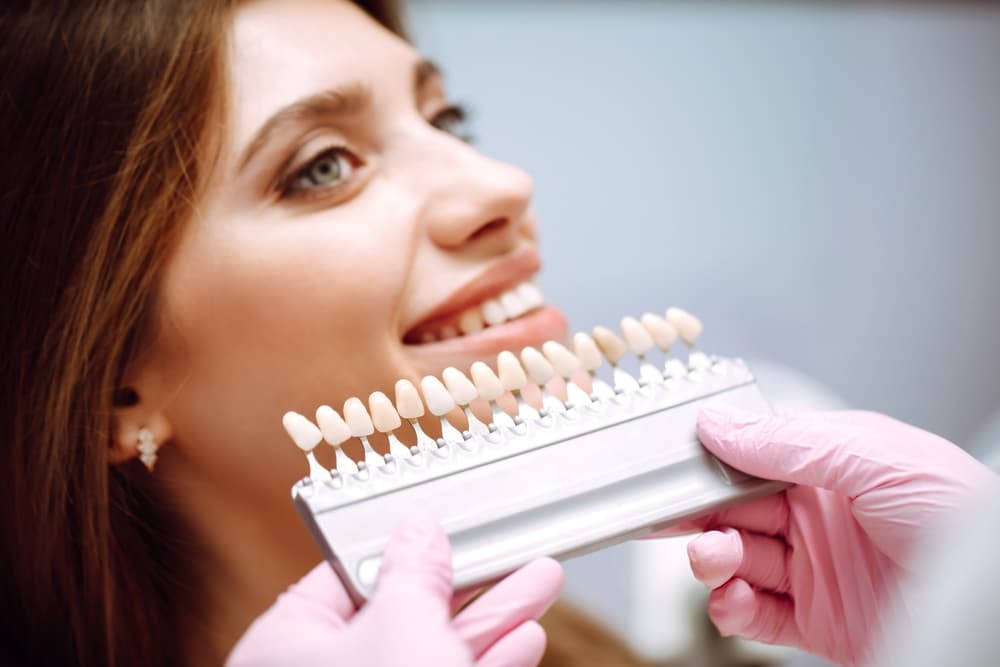
Feldspathic veneers are thin shells of feldspar-based glass ceramic, built up on the tooth model in successive layers by a dental technician and fired between each one.
That construction method is what separates feldspathic from everything else on a veneer menu. Most modern veneers are milled or pressed from a solid block of ceramic, which gives a strong and consistent restoration with a fairly uniform optical character, whereas feldspathic porcelain is stacked by hand so the technician can vary translucency, warmth and depth across a single tooth the way natural enamel varies from gumline to biting edge.
The material is also the oldest in cosmetic dentistry, which occasionally means it’s dismissed as outdated.
Feldspathic veneers can be made extremely thin, often a few tenths of a millimetre, which usually means removing very little enamel and sometimes almost none. How much preparation your teeth need depends on their existing position and shape rather than on the material.
WHY
FELDSPATHIC PORCELAIN LOOKS MORE NATURAL
Translucency is the reason, and it comes from what the material lacks rather than what it contains.
Stronger ceramics get their strength from a dense crystalline structure packed through the glass. Those crystals scatter light, which is what makes the material tough and also what makes it read as slightly more opaque. Feldspathic porcelain has far less of that reinforcement, so more light passes into the veneer and out again, picking up the colour of the tooth underneath on the way.
Depth is what that produces, and depth is what the eye reads as real. A feldspathic veneer shifts character slightly as the light around you changes, the way a real tooth does, instead of holding one flat shade under every condition.
That behaviour is most valuable across the upper front six teeth, sometimes called the social six, because those are the teeth visible in ordinary conversation. It also works particularly well over teeth that are only mildly discoloured or stained, where there is no need to block out the underlying colour. Heavy staining is the opposite case: translucency lets the darkness show through, and a more opaque material handles it better.
Because the shells can be shaped freely, feldspathic veneers are also useful for widening the appearance of narrow smiles, where the upper arch looks pinched and dark spaces appear at the corners of the mouth.

FELDSPATHICOR EMAX: WHICH MATERIAL SUITS YOU
Neither material is better than the other; they're optimised for different priorities, and choosing between them is a question about your bite and your expectations rather than about quality.
Feldspathic gives you the most natural optical result and the thinnest possible restoration. Emax veneers are lithium disilicate, considerably stronger in bulk, and better able to take load. If you grind your teeth, have a history of chipping, or need veneers further back in the mouth, strength should decide it, and Emax is the appropriate answer.
Feldspathic relies heavily on the bond to your enamel for its strength, which is why it performs well when bonded to healthy enamel across the front teeth and poorly under heavy bite forces. A bruxist in feldspathic veneers is a repair appointment waiting to happen.
We assess your bite, the wear already on your teeth and how much enamel you have before recommending either.
WHAT TO EXPECT DURING FELDSPATHIC VENEER TREATMENT
Treatment opens with an assessment and a discussion of what you want the result to look like, supported by a digital simulation of the proposed smile.
Any preparation needed is minimal and conservative with this material. We then take an impression or digital scan and photographs recording the character of your natural teeth, because the technician is matching translucency and surface texture rather than only a shade number.
Layering and firing at the laboratory takes longer than milling a veneer from a block, so allow a little more time between preparation and fitting than a machined restoration would need. Temporary veneers protect the teeth meanwhile.
Fitting is where feldspathic work is either won or lost. The shells are delicate before they’re bonded, and the bond itself carries much of the finished strength, so the isolation and bonding protocol matters more here than with a thicker, stronger ceramic.
We review the result after fitting and check the bite properly, since an interference that would be harmless on a crown can chip a thin veneer over months.


PROS AND CONS OF FELDSPATHIC VENEERS
Pros
- The most natural optical result of any veneer material, with genuine depth rather than a flat shade
- Can be made very thin, so enamel removal is usually minimal
- Hand-layered, so translucency and surface character can be varied tooth by tooth
- Highly stain resistant, as glazed porcelain does not absorb colour the way composite does
Cons
- Weaker in bulk than lithium disilicate, so unsuitable for grinders or for back teeth
- Depends on a strong bond to healthy enamel, which limits who is a candidate
- Takes longer to make, because layering and firing cannot be rushed
- Poor at masking heavy staining, since translucency lets dark underlying colour through
FELDSPATHIC VENEERS FITTED BY A LEADING COSMETIC DENTIST
Dr Joe Oliver (GDC No. 62456) qualified from King’s College Hospital in 1987 with a BDS and LDS RCS England, and has worked in cosmetic dentistry since opening the practice in 1989. He has placed over 40,000 porcelain veneers and is a member of the American Academy of Cosmetic Dentistry, as well as co-founder and Director of Education of Cosmetic Dental Seminars.
Material selection is the part of veneer work patients rarely get a proper conversation about, and it is the decision that determines whether the result looks like teeth or like veneers. Our assessment covers your bite, your enamel and what you actually want before any material is recommended.
Patients who already have veneers, and dislike how opaque they look, are one of the most common cases we see. Replacing old veneers with a more translucent material, such as feldspathic porcelain, is often the change that makes a smile stop looking like dentistry.

BOOK A FELDSPATHIC VENEERS CONSULTATION IN LONDON
What feldspathic veneers cost depends on how many teeth you are treating, how much preparation each one needs, and the laboratory work involved, so we quote against an examination rather than a price list. Our fees page has all the information you need, and finance is available through Chrysalis Finance.
Book a consultation at our Mayfair clinic on 020 7770 6441, or get in touch online. We will assess whether feldspathic is right for your bite, show you a simulation of the proposed result, and tell you plainly if a different material would serve you better.
FAQs about
FELDSPATHIC VENEERS
Why are feldspathic veneers more translucent than other porcelains?
They contain far less crystalline reinforcement than stronger ceramics such as lithium disilicate. Those crystals give strength but scatter light, so removing most of them lets light pass through the veneer much as it passes into natural enamel. Translucency and strength trade off against each other in every dental ceramic.
Are feldspathic veneers strong enough for everyday use?
For upper front teeth bonded to healthy enamel in a patient who does not grind, yes, and they have been used that way for decades. They’re not the right material for molars or for anyone with significant bruxism, where the bite forces exceed what a thin feldspathic shell should be asked to carry.
Do feldspathic veneers stain?
Glazed porcelain resists staining well and does not absorb colour the way composite does, so coffee, tea and red wine affect the veneer itself very little. What can change over years is the appearance at the margins where the veneer meets the tooth, which is one of the things we check at reviews.
Can feldspathic veneers be placed on back teeth?
We would not recommend it. Molars and premolars carry the heaviest chewing forces in the mouth, and those are the sites where the strength difference between feldspathic and lithium disilicate matters most. Aesthetic priority belongs at the front, where the teeth are actually seen.
Do feldspathic veneers last as long as Emax?
Well-made porcelain veneers of either type can last many years with good care, but feldspathic is the more delicate of the two and asks more of the patient in return for the aesthetic result. Grinding, nail biting and chewing hard objects shorten the life of a thin veneer considerably faster than they shorten a thicker, stronger one. A nightguard is sensible if you grind at all.
How much enamel is removed for feldspathic veneers?
Usually very little, and occasionally almost none, because the shells can be made so thin. How much comes off depends on where your teeth currently sit rather than on the material: a tooth that is already positioned well needs barely any preparation, while one that sits forward of the arch needs more to avoid a bulky result.
GET THE SMILE
YOU ALWAYS DREAMT OF
Start your dental treatment immediately with a payment option, tailored to your budget and requirements.
Why not treat yourself
to the smile you have
always wanted
To start your smile transformation today, book a free online consultation with the best.
Enquire for our Prices
Complete your details and we will contact you with more information including our current price list